Some afternoons in my home office my head just gets heavy. Not sleepy exactly — slow to start, hard to hold a thought, the kind of state you blame on yourself.
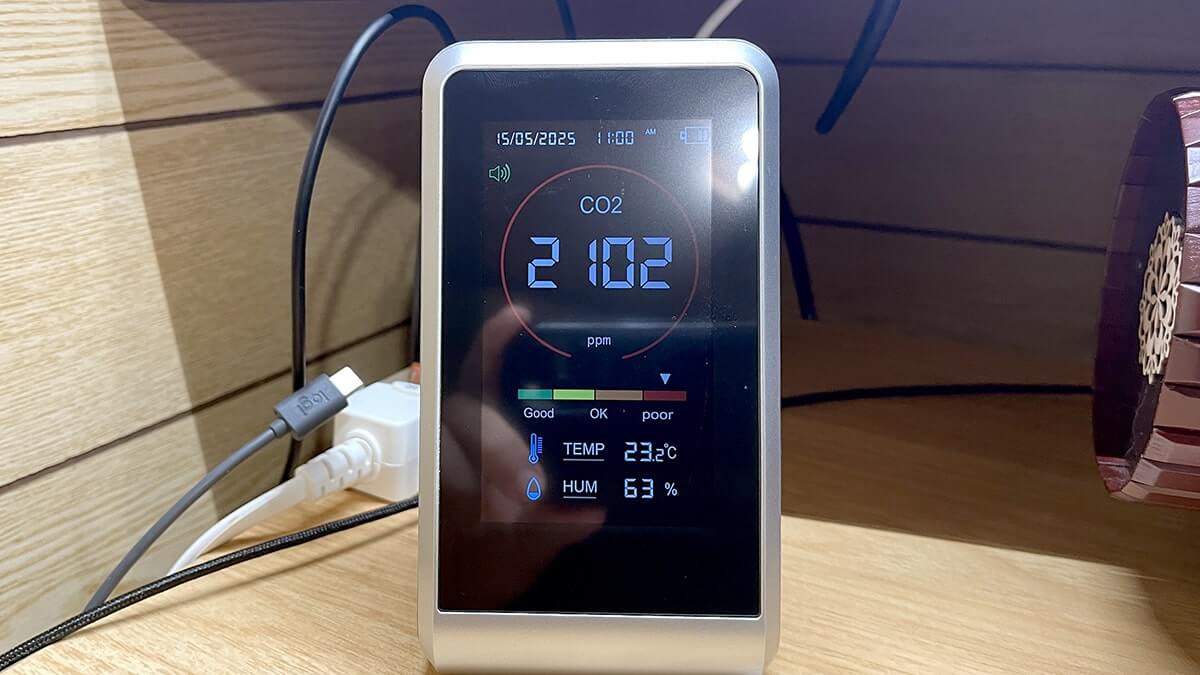
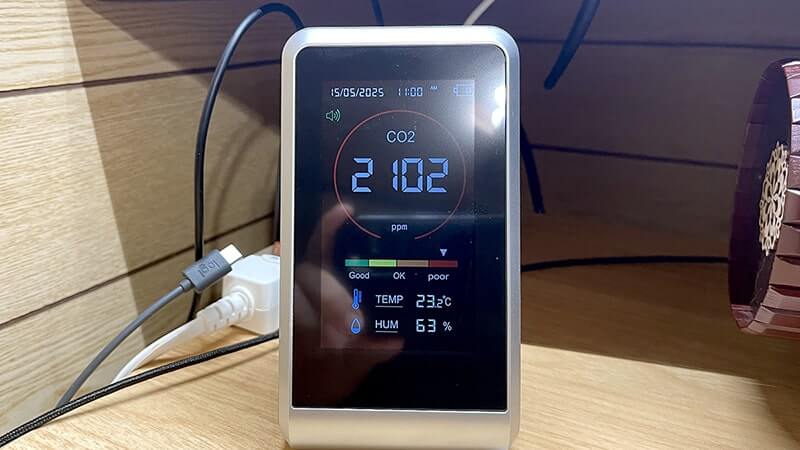
I put a CO2 meter on the desk to find out whether the room was part of it. The first reading, on an ordinary unventilated afternoon, was 2,106 ppm. Five minutes with the window open took it to 692 ppm.
This is what a year of watching that number changed about how I work, what the readings actually looked like, and what to check before buying one of these.
Originally published in Japanese on September 15, 2025. This English version was written in September 2026.
A note on the hardware: the meter I bought is a Japanese-market unit (TOAMIT’s “CO2 Manager”) that is not sold internationally. The specific model matters much less than the habit, so this article is written around what the numbers showed and what to look for in any equivalent monitor, rather than as a recommendation for that particular box.
Why indoor CO2 is a proxy for ventilation
You are the CO2 source. In a closed room with a person in it, the concentration climbs steadily; open a path to outside air and it falls. That makes it a convenient stand-in for a question you cannot otherwise answer by feel: is fresh air actually reaching this room right now?
Outdoor air sits somewhere around 430 ppm today, so that is the floor a room can approach with the window open.
Above that, the guidance is less unanimous than most articles on this subject suggest, and it is worth being accurate about, because these numbers are not four versions of the same rule:
- Japan: 1,000 ppm, and it is binding. This is the figure I started with. The Building Sanitation Management Standards under Japan’s Building Sanitation Act set 1,000 ppm as a legal requirement — but for specified large buildings, not homes. Thousands of buildings are tested against it every year.
- US CDC: below 800 ppm, as an indicator. Offered explicitly as one possible target for what good ventilation looks like, with the immediate caveat that a single value will not suit every space.
- UK HSE: 1,500 ppm is the action line. Readings consistently above it indicate poor ventilation and mean you should act. HSE also states plainly that CO2 readings are a broad guide to ventilation and do not demonstrate a safe level.
- ASHRAE: deliberately no number at all. This is the one most commonly got wrong. ASHRAE Standard 62.1 did carry a 1,000 ppm limit in its 1989 edition and removed it, because it was so consistently misread. ASHRAE’s current position document says the standard “does not provide a limit value for indoor CO2” and that it does not recommend any specific concentration as a measure of ventilation adequacy.
- WHO: no figure exists. The WHO indoor air quality guidelines cover carbon monoxide, formaldehyde, radon and others. Carbon dioxide is not among them.
ASHRAE’s reason for refusing to name a number is the most useful thing in any of these documents: the CO2 level that corresponds to adequate ventilation depends on the room. At the ventilation rates the standard requires, steady-state CO2 works out around 1,000 ppm in an office, 1,500–2,000 ppm in a restaurant or lecture hall, and above 2,500 ppm in a conference room. A universal threshold is a simplification, and once you know that, “under 1,000” stops being a rule and becomes what it actually is — a reasonable personal trigger for a small office-like room.
One number that does not belong in this conversation, and which gets dragged in constantly: the 5,000 ppm OSHA and NIOSH occupational limits. Those are eight-hour workplace toxicity thresholds, five times higher than any of the figures above, and they are answering a completely different question. If an article reassures you that you are “well under the safety limit” at 2,000 ppm, that is the number it is quietly using.
The common thread worth holding on to: at these concentrations CO2 is not what is harming you — it is evidence that the air is not being exchanged, and therefore that nothing else in the air is being removed either. My apartment workroom is not a managed office building, and I am not trying to hold it to a legal standard. But as a “you have probably not opened a window in a while” line, 1,000 ppm turned out to be a good one.
The numbers in an actual home office
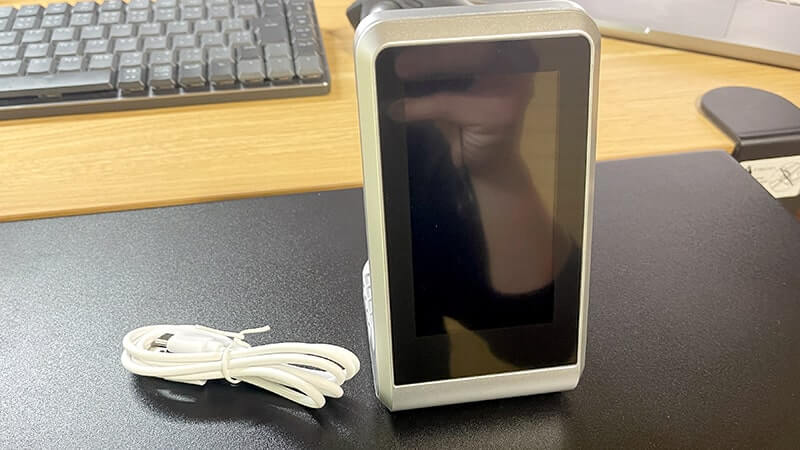
The meter sits next to the monitor, USB powered, showing CO2 alongside temperature and humidity, with a green / yellow / red band so I can read it at a glance without actually reading it. Measuring range 400–5,000 ppm. No setup beyond plugging it in.
What a normal day looks like:
- Morning, room just opened up: 600-something ppm.
- An hour into a video call, door and window shut: past 1,000 ppm. This one genuinely surprised me. Talking raises your breathing rate, and calls are exactly when you are least likely to get up and open something.
- Late afternoon, closed room, no ventilation all day: 2,106 ppm — measured on the first day I owned the thing, during precisely the “head feels heavy” stretch I had been writing off as mood.
- Five minutes of cross-ventilation: 692 ppm. Not a gradual drift — a drop.
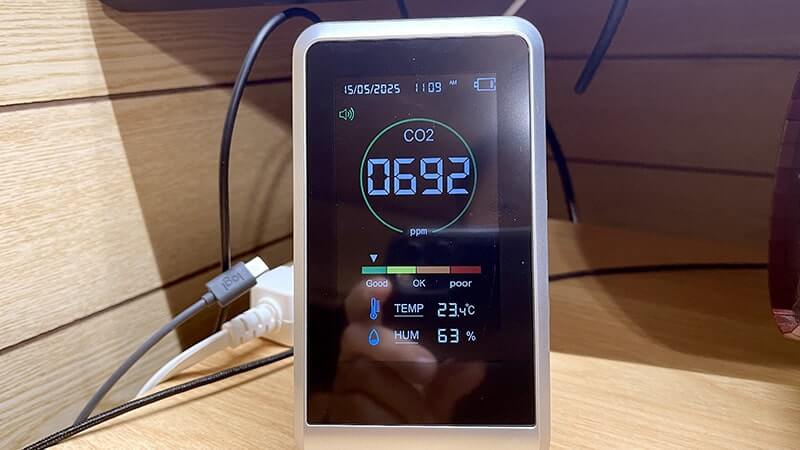
That last one is the finding that changed my behavior. I had assumed airing out a room was a twenty-minute commitment. It is not. Five minutes of actual airflow does most of the work, which makes it small enough to do between tasks instead of postponing it.
The seasonal trap is obvious in hindsight: summer means air conditioning, winter means it is cold outside, and both mean the windows stay shut all day. The months when you least want to open a window are the months the number climbs highest.

What I do with it now
The routine ended up being simple enough that it stuck: open the windows first thing in the morning, and when the display gets near 1,000 ppm during the day, open something for five minutes.
Below roughly 800 ppm I find it easier to get started on work. I want to be careful about how much weight that carries — it is one person’s impression, in one room, with no control for sleep, caffeine, or what was actually on the to-do list that day. Research on CO2 and cognitive performance at these concentrations is genuinely mixed, and I am not in a position to add to it.
What I will claim is narrower and, I think, more useful: I now know when the room is stuffy instead of guessing, and the cost of fixing it turned out to be five minutes. Whether the improvement afterwards is physiological or just the small reset of standing up and opening a window, the loop is cheap and it runs.
The other quiet benefit is diagnostic. When a meeting leaves me unreasonably tired, “the room was at 1,400 ppm” is now one of the things I can check, rather than assuming the meeting was the problem.
What to check before buying one
Since the unit I bought is Japan-only, the more useful thing I can offer is the shortlist I would use if I were buying again anywhere else.
- Confirm it is a real NDIR sensor. This is the one that matters. A large share of cheap “CO2 monitors” use a low-cost VOC sensor and estimate CO2 from it — usually labeled eCO2 or “equivalent CO2”. Those numbers respond to cooking, cleaning products and alcohol, and they will not tell you what you are trying to learn. If a listing does not say NDIR, assume it is not.
- Check how it calibrates. Most NDIR units use automatic baseline calibration, which assumes the room reaches outdoor levels periodically. In a room that is genuinely never aired out, that assumption drifts. Manual calibration — take it outside, tell it that is roughly 430 ppm — is a useful escape hatch to have.
- Temperature and humidity on the same display. Minor, but you end up wanting all three, and a second gadget is a second thing on the desk.
- Continuous display beats an app. The value is entirely in glancing at it mid-task. Anything that requires unlocking a phone will not get looked at.
- USB power, and put it at head height. Near where you actually sit, away from the direct path of your own breath and away from the window, or you are measuring the wrong thing.
Air is part of the desk setup
When people talk about improving a home office, the list is desk, monitor, chair, lighting. All visible, all things you can photograph.
Air is the one input you are taking in continuously for eight hours and the only one with no feedback at all. A cheap meter converts it into a number you can act on, and the action costs five minutes. Of everything I have added to this room, it was the least interesting purchase and one of the more useful ones.
References
- Ministry of Health, Labour and Welfare (Japan): required ventilation rates for indoor air quality (PDF, Japanese) — the source of the 1,000 ppm figure, alongside the Building Sanitation Management Standards.
- ASHRAE Position Document on Indoor Carbon Dioxide (PDF, approved February 2025) — why Standard 62.1 has no CO2 limit, and the per-space-type figures quoted above.
- NIST: “Quit Blaming ASHRAE Standard 62.1 for 1000 ppm CO2” (PDF) — a short, readable account of where the misattribution came from.
- CDC / NIOSH: ventilation FAQ — the 800 ppm indicator target.
- UK HSE: using CO2 monitors — the 1,500 ppm action line and the caveats attached to it.
- US EPA: can I measure CO2 indoors to get information about ventilation? — notable for declining to give a number.
The meter itself is TOAMIT’s TOA-CO2MG-001, still sold in Japan at ¥7,680 as of September 2026 — roughly US$50 — with no international distribution.