
In March 2026, a friend and I went fishing and camping on Niijima, an island off Tokyo. I came home with footage from an iPhone and a GoPro, but the editing sat untouched for months.
In November, I worked with Claude Code to turn those 295 clips into a travel film of about 68 minutes. The AI assembled cuts, added subtitles, and rendered the video. I chose between samples, gave timestamped corrections, and checked the finished picture and sound.
This was not a trip generated from a prompt. It was an edit of footage we had actually shot, built with code and editing data. What follows is a record of the work I handed over and the decisions I still had to make.
The finished film leaves room for the trip itself
We crossed to the island on an overnight ferry in rough weather, went fishing, and cooked fish and squid we caught. The finished film runs approximately 67 minutes and 45 seconds; I round that to “about 68 minutes” here. The film and the text in the production samples are in Japanese. English captions below explain what each sample shows.
I did not want only a short sequence of catches. I wanted to leave in some of the time we spent looking at the sea and sitting over a meal. That became a practical editing criterion: a moment could be worth keeping even when nothing dramatic happened.
The trip itself starts with my overnight-ferry field notes on moss (in Japanese). This article is about turning that trip into a film.
Claude Code edited; I made the editorial decisions
Claude Code handled the main editing workflow: organising footage, proposing structure, preparing a cut list, building the tools for the edit, and rendering. I was not joining each shot by hand on an editing application’s timeline.
| Role | Work in this project |
|---|---|
| Claude Code | Footage organisation, transcription, structure and cut lists, video and subtitle assembly, rendering |
| Other AI agents, including Codex | Checks of structure, release materials and specified details; manga reconstruction of events we had not filmed |
| Me | Filming, sample selection, timestamped corrections, listening, checking with my friend, choosing the title and thumbnail, uploading and publishing |
The workflow used whisper.cpp for transcription and tools including FFmpeg for video and audio processing. Claude Code was producing code and editing data to use those tools, not pressing a single “edit video” button.
Work began on November 10 and the film was published on November 20: eleven calendar days. That is not eleven days of continuous processing or eleven days in which I did nothing. I did not measure my working hours or the cost, so I cannot give a defensible comparison of time or money saved.
Even putting 295 clips in order required checking their contents
The starting material was 263 iPhone clips, 28 GoPro clips, and four clips from my friend: 295 files, about 61.4 GB in total. The first task was to organise them around what happened during the trip.
The GoPro’s clock was wrong. Sorting by timestamps alone would not produce the right sequence. Footage of the same events from the iPhone and GoPro had to be compared to correct the order. The contents mattered more than the date stored in a file.
Transcripts helped with structure, but readable text was not proof of correct speech. Wind or silence could produce plausible-looking words. Both the words and the speaker needed checking before the text became a subtitle.
Missing footage became an explicitly reconstructed manga scene
When the material was examined, we could not find footage covering the sequence from hooking a large bigfin reef squid to landing it. It was an important event in the trip, but the camera had not preserved that sequence. I used manga to cover the missing part.
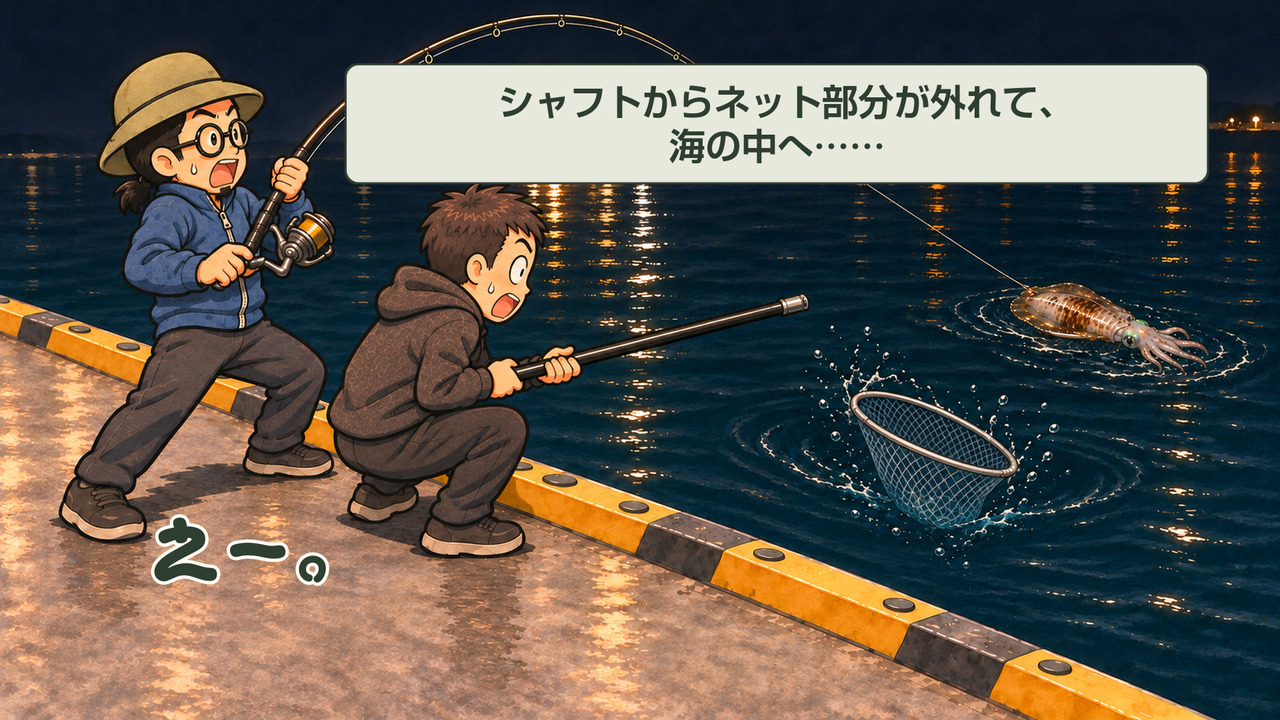
In this panel I am holding the rod while my friend reaches out with the landing net. The Japanese text says that the net head detached from the shaft and went into the sea, followed by an exclamation of surprise. I checked the wording against the original trip record.
Manga can show the order of an event we did not film. But adding an unrecorded motive or feeling would turn it into a different story. Summarised dialogue had also led to speaker mix-ups, so the original writing needed to be checked before assigning lines. Clothing and the way tools were held needed attention too.
The point was not to fill the gap with something that looked like authentic footage. It was to make the boundary between a recording and a reconstruction visible.
Still images for appearance; short videos for sound and pacing
If the first thing I received was a long render, disliking a subtitle position would mean waiting for another long render. Instead, I asked for still-image samples first. We compared type, placement, and colour before moving into video.
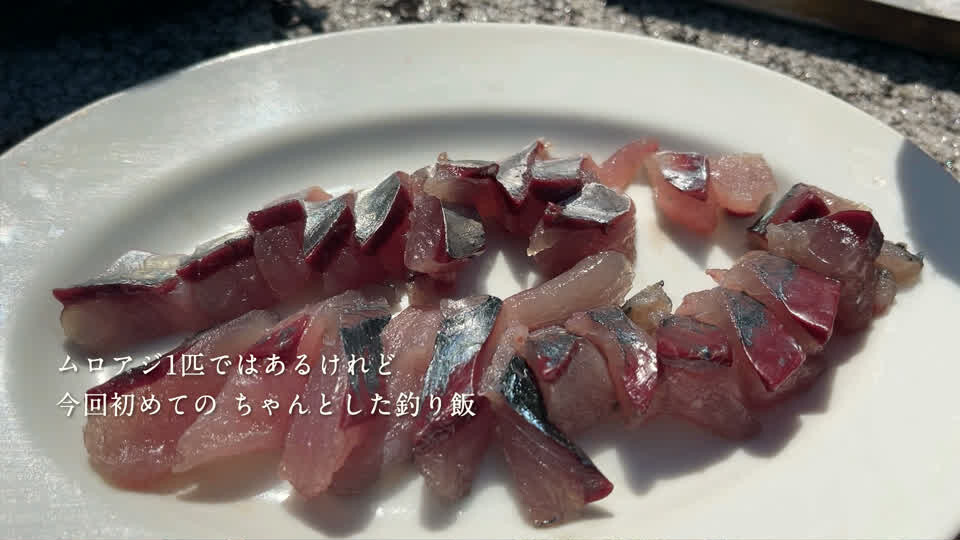
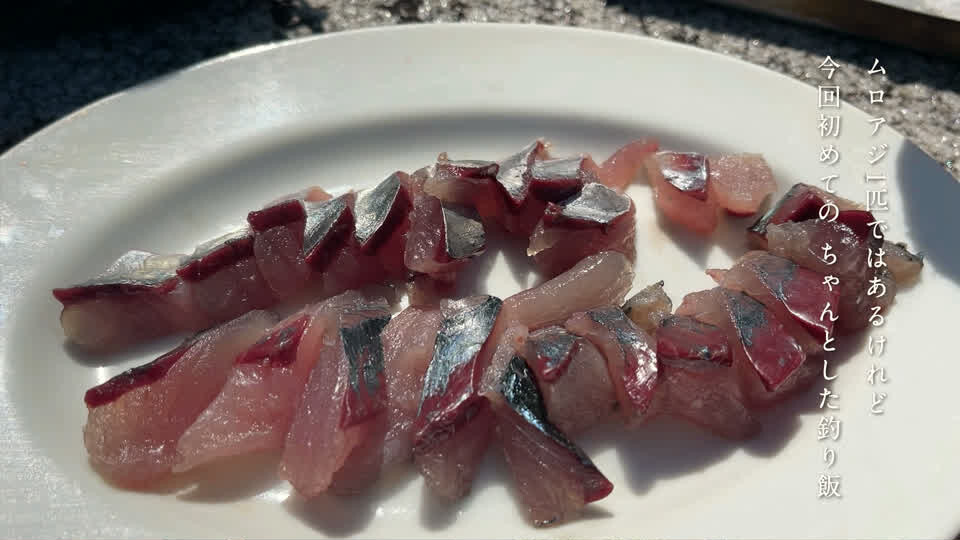
We settled on vertical narration at the upper right, with dialogue at the bottom. My lines were white and my friend’s a pale cream. Establishing those positions reduced the number of decisions to revisit in later scenes.
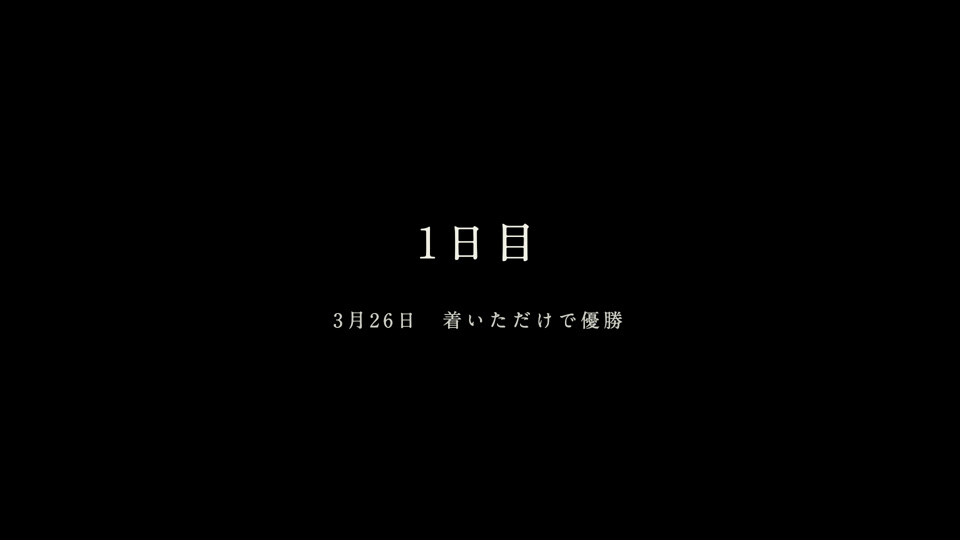
The stills settled appearance, not sound or duration. I compared short videos to choose chapter-card sound effects, music levels, and how long subtitles stayed on screen. A transcript or a loudness measurement is not the same thing as hearing whether a transition feels right.
In an early sample, subtitles disappeared before I could finish reading them and individual shots felt too short. I asked for more room, even if that made the scene slower. A lunch sample went from about 58 seconds to about 100 seconds. That was a decision about one scene, not a multiplier applied to the whole film.
Work a day at a time, and send corrections with timestamps
The cycle was structure, cut list, short review video, then corrections. We divided the trip into days and improved each chapter before moving to the next.
“Something feels wrong” does not identify an edit. A subtitle disappears too soon; a meal and a ferry announcement are in the wrong order; this shot needs a longer pause. When reviewing a longer sequence, I attached timestamps to those comments.
I also did not want the editing instructions to exist only in chat. A cut list records which part of a clip to use and which subtitles and sounds belong with it. That makes changes between renders easier to follow.
| Section to use | What to keep | What to check |
|---|---|---|
| Clip A, 00:03–00:10 | The approach to the island and location sound | Does the transition leave enough time to establish the place? |
| Clip B, 00:05–00:14 | A short conversation and subtitles | Do the speaker and timing match? |
| Clip C, 00:02–00:11 | Hands preparing food and a pause | Can the subtitle be read before the cut? |
Music needed editorial decisions too. I used songs I had made under the name odeco and selected them scene by scene. Rather than changing music volume around every line of dialogue, I chose adjustments at scene boundaries and listened to how the voice and music sat together.
Subtitle timing and rendering still caused problems
Handing the work to AI did not make the first output ready to use. In particular, a subtitle could contain the right words but appear before the voice.
The process included rechecking where speech started and ended and comparing transcriptions of shorter audio segments. I then listened to the actual audio and gave corrections. That describes adjustments needed for this film; it is not a guarantee of accurate subtitles for any recording.
Long renders also became heavy to process. The workflow was changed to handle shorter sections. Being able to redo an affected section was easier to manage than rendering the entire film again.
Adding editing tools also left an existing tool unable to run at one point. For another attempt, I would avoid updating a working environment wholesale: check the versions and basic operation first. Original footage also needs to stay separate from working files.
Another AI’s checks did not replace my full viewing
I asked Codex to check the structure and, before release, the supporting materials and specified details. A separate perspective helped: a missing map attribution was corrected during release preparation, for example.
That does not mean another AI continuously watched and listened to all 68 minutes or guaranteed everything in the film. I watched the full video and made the final decisions about its flow and sound. My friend checked it too. I chose the title and thumbnail, then uploaded and published it myself.
I have written about separating creation from review with Codex and Claude. Reviewing a film is not the same task as reviewing a code diff. What carries over is keeping track of which materials were checked and which parts have not been watched or heard.
Passing manga work and checks to another agent also connects to the bridge between my existing Claude Code and Codex chats. Reducing the handoff work does not remove the decision about whether to accept the returned image or text.
Start with three to five short clips and one scene
You do not need to begin with a feature-length edit. Copy three to five short clips that you shot and have permission to edit and share. Ask for one scene. That is enough to test what information you need to supply and whether the returned material helps you make decisions.
Here is an illustrative request for that first scene, not a quotation from this project’s chat:
Use only the copied short clips to make one scene, from preparing a meal to eating it. Do not change or delete the originals.
First organise the contents and sequence. Propose a cut list with the sections to use, dialogue to keep, and subtitle text. Flag uncertain words or speakers for review instead of guessing.
Show still-image layout samples first. After approval, render a short review video to a new file. Ask before adding or updating tools or sending footage to an external service. Do not upload or publish it.
What leaves your machine depends on the AI and transcription setup. Footage can contain faces, conversations, and location information. A local working folder does not mean that no information is sent elsewhere. Check the services’ data handling and permission from the people shown before supplying the material.
Review the cut list, then stills, then the short video. Can you finish reading the subtitles? Can you hear the voice you wanted to keep? Has the sequence of events changed? Record the decisions you agree on for that scene and carry them into the next.
Keep originals and working storage separate
The source footage is only part of the storage requirement. Preview videos and intermediate renders accumulate too. A separate working drive can make that easier to organise; the capacity you need depends on the footage and workflow. Moving originals to one SSD is not itself a backup. Keep another copy elsewhere.
I delegated the edit, not the choice of what to preserve
I handed over finding footage, arranging shots, adding text, and rendering. But wanting lunch to unfold more slowly, noticing an uncomfortable sound, or recognising that events were out of order still required me to watch, listen, and explain.
Instead of asking for everything at once, I could choose samples, make a small section, and carry corrections forward. That repetition turned footage I had left sitting on a drive into a film. Next time, I would still start with one scene and check whether it preserves the time I wanted to remember.